Microsoft Defender for Office 365 includes its own phishing simulation and awareness platform, Attack Simulation Training. Because it sits deep inside Microsoft 365, many organizations assume it is the logical choice for phishing simulations and employee awareness.
And honestly: in some areas it is very good. But there is another side that organizations should understand before they replace a specialized awareness platform with it.
This article is intentionally balanced. There are clear advantages — and there are structural limitations that become visible very quickly in larger or more mature security environments.
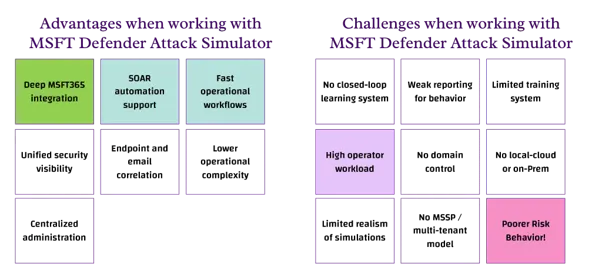
The positive side of Defender Attack Simulator
The advantages below are real, but they are not necessarily unique selling points: other providers may offer similar features or benefits.
Interim conclusion: the strength of the Microsoft Attack Simulator lies in its integration into the Microsoft Defender stack, especially with Microsoft Sentinel. For an organization with the size, structure and system landscape to benefit from operational consolidation, that is a genuine advantage.
The weak side of Defender Attack Simulator
What follows looks at one thing only: improving the risk behavior of employees, and the Attack Simulator as the product Microsoft offers for that purpose. These are the challenges we identified in use.
Simulation alone will never solve poor risk behavior
This is not only a Microsoft problem — it affects large parts of the awareness industry. The narrative that trained users alone stop phishing attacks is unrealistic. Without strong technical controls such as advanced email filtering, endpoint protection, browser security, identity protection and automated detection, users would be completely overwhelmed. Especially with AI-generated phishing, technical detection becomes more important again, not less.
The other half is the harder one. Companies implement technological safeguards through systems relatively quickly. Fostering sound risk behavior among people is a much more time-consuming endeavour — and conventional awareness does not help in this regard.
Pros and cons at a glance
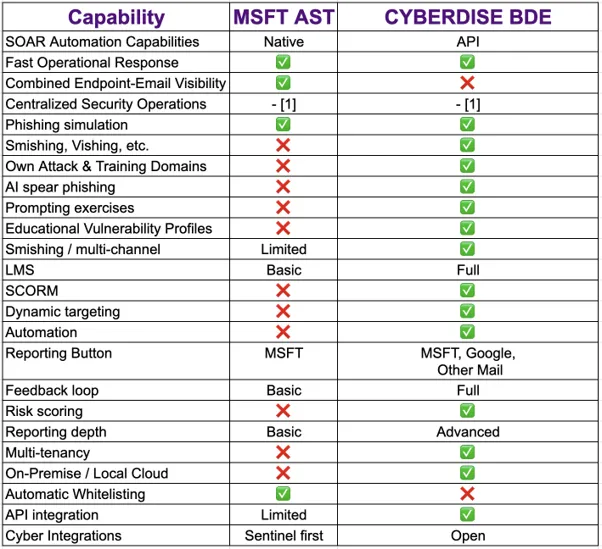
There are third-party products that integrate very well into existing system architectures, which can largely offset the advantage of Microsoft's tight integration into its own stack. CYBERDISE Behavioral Defense Engineering (BDE) was specifically designed and built for such scenarios. The comparison below follows the points covered in this article.
Stops after click detection, credential submission and a basic user assignment.
Continuous adaptive learning, reinforcement and long-term learning cycles.
Campaigns still feel standardized next to modern real-world phishing.
Personalized and sophisticated scenarios rather than a template library.
Functional, but limited compared to specialized awareness analytics.
Reporting behavior, hesitation and repeat patterns, learning progression, long-term trends.
Limited flexibility for phishing domains, reputation, landing pages and sender infrastructure.
Dedicated domains and landing pages under the program's own control.
Primarily designed around individual tenant operation.
Built for multiple AD domains, managed SOC providers and multi-customer operation.
Hybrid, regulated or on-premise environments run into limitations.
Deployment follows the regulatory and infrastructure situation, not the vendor's.
Conclusion
Microsoft Defender Attack Simulator is operationally strong inside the Microsoft ecosystem. But organizations should not confuse phishing simulations with complete security awareness maturity — or with people who actually demonstrate good risk behavior.
It is up to the procuring organization to decide which aspects of cyber security are a priority for it. The fact is that in the age of AI, attacks are far more sophisticated and occur far more quickly. But while companies can control and master the technological side relatively quickly, doing so with people is a much more protracted endeavour.
Those who want a more provocative reading will find another article on the same product.