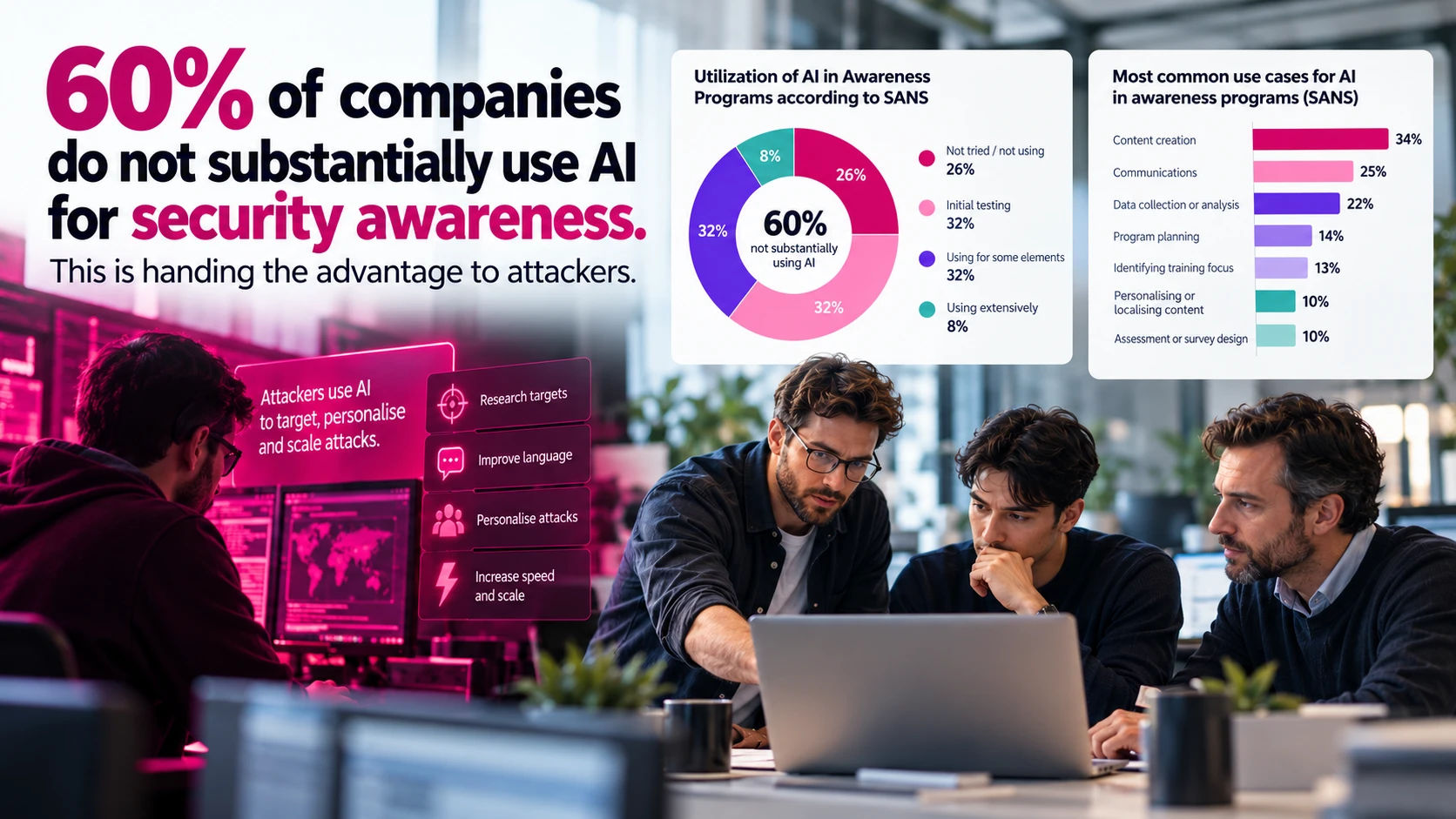
Attackers are not debating whether AI is mature enough to use. They are already using it to research targets, improve language, personalise attacks and increase the speed at which social engineering can be prepared and adapted.
On the defensive side, however, AI in security awareness appears to be moving considerably more slowly.
The 2026 Security Awareness & Culture Report from the SANS Institute, one of the best known cybersecurity training and research organisations in our industry, provides some interesting numbers here. At first glance, adoption looks advanced because around three quarters of awareness teams report some engagement with AI. But the detail tells a different story: 26% have not tried or are not using AI at all, another 32% have only started testing initial capabilities, 32% use it for some elements of their program, and only 8% use it extensively.
Source: SANS 2026 Security Awareness & Culture Report
My interpretation is therefore a little different from simply saying that “75% use AI”: 58% of security awareness teams have either not started or have not moved beyond initial experimentation yet.
Six out of ten are not really doing AI awareness. This does not mean they reject AI. SANS itself describes adoption as still being in its infancy. But I still find the number remarkable, because attackers are certainly not waiting for us to finish experimenting.
The first generation of awareness AI is quite predictable
The SANS breakdown of use cases is even more interesting. Content creation is the most common use case at 34%, followed by communications at 25% and data collection or analysis at 22%. Program planning reaches 14%, identifying training focus 13%, while personalising or localising content and assessment or survey design both sit at only 10%.
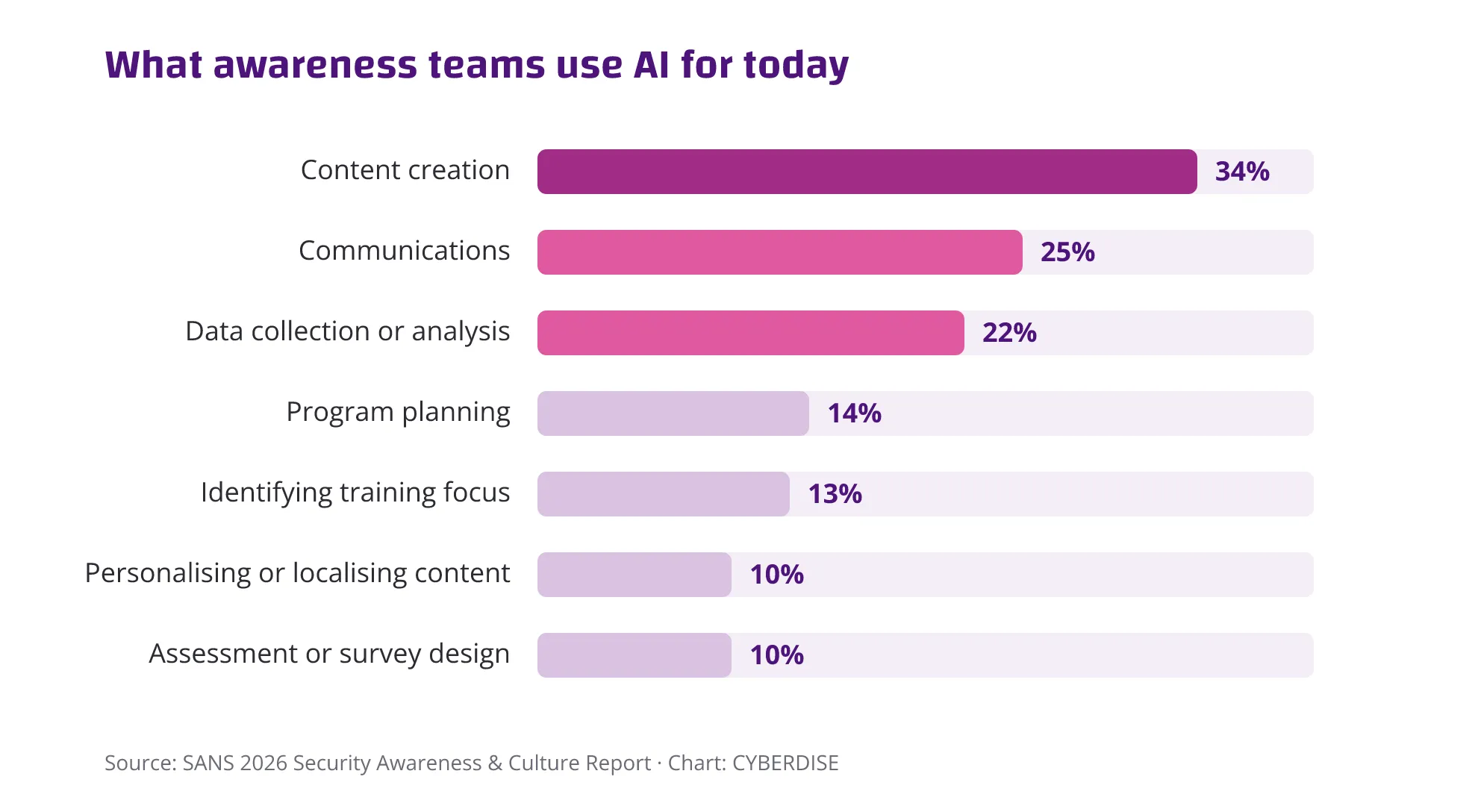
This all makes sense. Ask someone how AI can support an awareness professional and the first answers are usually practical: write an email, create an image, create or translate a course, etc. Of course this is useful! But this is only the beginning.
When I looked at the chart, I immediately asked myself where I would put some of the AI use cases we are already working with. Where does prompting an entire awareness campaign belong? Is that program planning, content creation or personalisation? Where does an AI-supported OSINT process for populating our educational vulnerability profile fit (it helps understand the context around a target group and create very realistic exercises)? And where would this educational vulnerability profile belong if it influences which exercise a person receives next?
These were exactly the questions that popped up in my head when I originally read the report. My conclusion is that most organisations still think of AI in security awareness primarily as helping the awareness professional perform the existing job faster.
The more interesting development is AI changing how the awareness program itself works.
AI beside the program or AI inside the program
There is a substantial difference between the two.
Beside: In the first model, the awareness manager has an AI assistant. AI helps create text, translate content, analyse data or prepare communications. This saves time and is useful.
Inside: In the second model, AI becomes part of the awareness machinery itself. The awareness professional starts with the behaviour that should be influenced, together with the target group, role, business context and current threat. AI can then help create relevant scenarios, adapt language and context, generate variants, analyse what happened and support the decision about what should happen next.
That is also much closer to how the criminals are using AI.
The bad guys don't use AI to make prettier PPTs
AI has become the second highest human risk identified by security awareness professionals in the SANS report, behind only social engineering. SANS also notes that employees are adopting AI faster than policies and training can keep up, while AI-related risks are evolving faster than an annual training calendar can reasonably follow.
On the offensive (bad guy) side, AI can help research targets, improve language, imitate communication styles and adapt attacks at speed and scale. On the defensive awareness side, a significant part of the market is still discovering how useful AI can be for creating videos and communications.
Again: there is nothing wrong with using AI for content creation. We do it too, but if that remains the dominant use case, the asymmetry worries me. The real opportunity is to use the same characteristics that make AI attractive to attackers, namely speed, scale, personalisation and adaptability, to improve human defenses.
Personalisation still needs context and organisational relevance
Relevance, context and reproducibility: the future of awareness is not an AI machine endlessly producing campaigns without an awareness professional involved.
Effective interventions need context. They need an understanding of the organisation, the employee or target group, the role, current threats and the behaviour that should actually change.
An awareness manager may know that Finance is involved in an acquisition, HR is introducing a new portal, an executive travels extensively or the SOC is seeing a specific social engineering technique. That knowledge can turn a generic simulation into something employees may realistically encounter.
And it must also be possible to specify or manually design specific campaigns. When it comes to measuring success and KPIs, it must also be possible to reproduce awareness-building campaigns in a controlled and deterministic manner. And all experts with extensive experience in AI know that determinism isn't exactly the strong spot of AI agents.
AI can significantly speed up the creation of such campaigns and make them more scalable, but the quality of the input data and the awareness professional’s judgment remain crucial. Equally crucial is the ability to monitor and manually adjust AI campaigns or preparatory work. This must be possible.
That’s why I see AI as a tool that makes a good awareness professional better, not as a replacement.
The interesting part starts after the campaign
There is another reason why I think the current adoption numbers underestimate the potential.
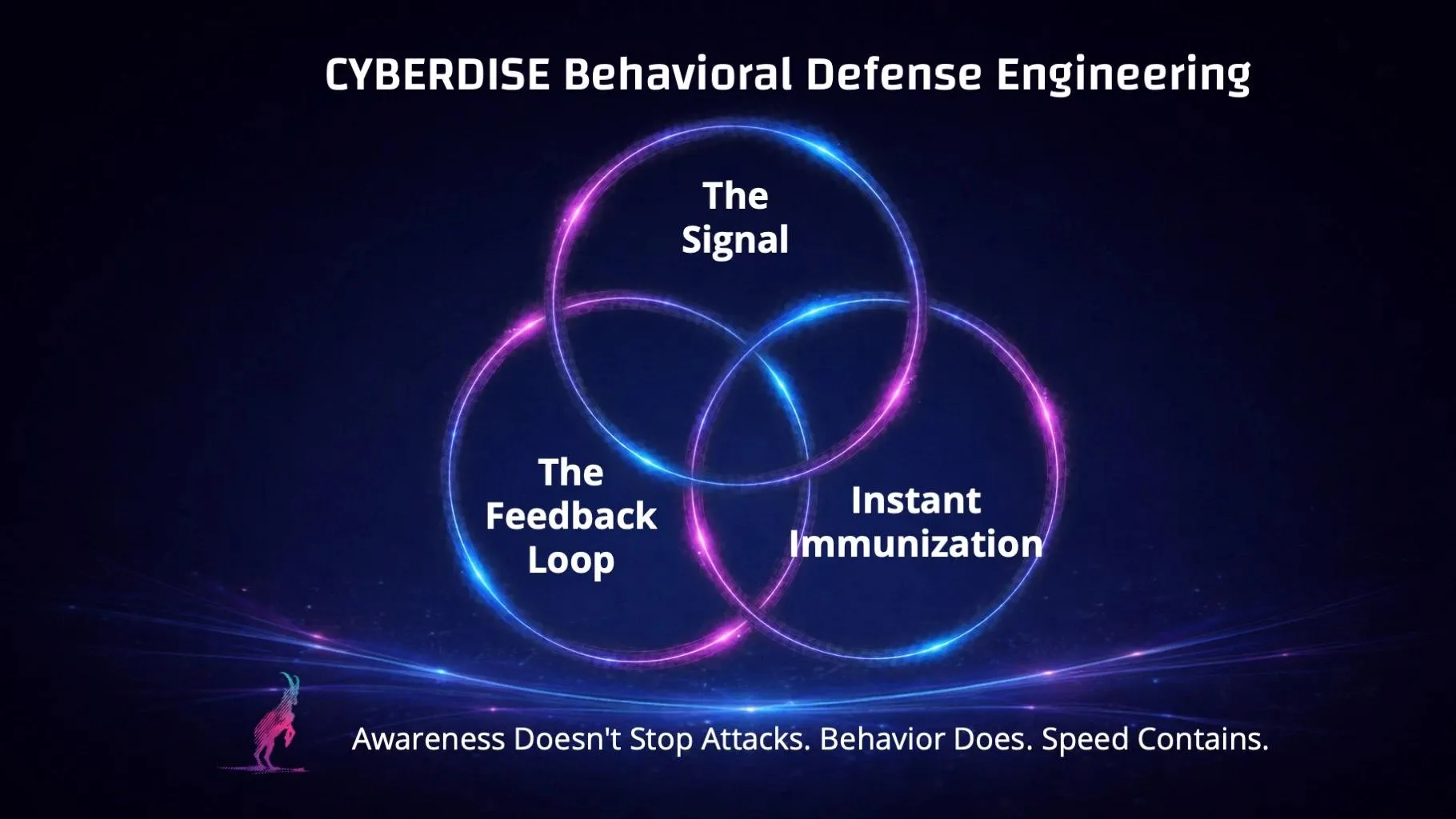
Security awareness should increasingly work as a loop rather than as a publishing process. In our Behavioral Defense Engineering (BDE) approach, we describe that loop through four dimensions:
AI can add value across all four. Employee reports can be analysed and grouped, patterns can influence which behaviours deserve attention, exercises can be adapted to roles and situations, and feedback can become faster and more contextual.
The question then changes from “Can AI write me another phishing email?” to something much more interesting: how can AI help an organisation continually observe, exercise and improve the behaviours that matter when an attack actually happens?
That is where I believe the development is heading.
So are 6 in 10 awareness teams really behind?
“Behind” may be too simplistic because this development is still young. Even SANS describes AI adoption as being in its infancy, and only 2.4% of respondents said they had tried AI and concluded that it was not useful. The dominant reaction is therefore not rejection, but experimentation.
Still, experimentation creates a temporary strategic window of opportunity: if almost six out of ten teams have not progressed beyond initial testing, organisations that learn earlier how to integrate AI meaningfully into their awareness programs can build experience while others are still evaluating basic use cases.
From our perspective at CYBERDISE, this is one reason why we have been pushing AI beyond pure content creation and a cybersecurity chatbot (which we provide as well, of course). Prompting campaigns, contextual and OSINT-supported personalisation, behavioural analysis and AI-supported exercises are not simply productivity features. They are part of making awareness more adaptive, more relevant and more closely connected to actual human risk.
To me, it's crystal clear that some of today's categories will be considered outdated in a few years. We on the team already feel that when people say AI is used to create content, it sounds a lot like saying a computer is used to write documents.
The more important question will be what the whole awareness system can do differently because AI is inside it. I am convinced I know the answer: almost everything. AI is already reshaping the day-to-day operational work of awareness managers and operators, at least in our products.
SANS is probably right that the adoption of AI in security awareness is only beginning. For awareness professionals, that should not be a reason to wait, but rather an opportunity to experiment with those applications that can genuinely improve human behaviour instead of simply generating more content.
This is because attackers don't evaluate AI based on how many content assets it generates, but rather on how many of their attacks are successful.
Perhaps we should apply the same standard to ours, because awareness doesn't stop attacks. Behavior does.
So Long, Palo Stacho
Palo Stacho is CEO of CYBERDISE and a cybersecurity entrepreneur with 30 years of industry experience. He is also a board member, scale-up trainer and speaker. He lives with his family in Switzerland.